Every office runs on paper — less than it used to, but more than anyone admits. Active files, reference binders, HR records, financial documents, marketing samples, office supplies: they all need a home. Without a proper storage plan, they end up in the worst places — stacked on desks, piled on the floor, crammed into closets. Good filing and storage is not glamorous, but it is the difference between an office that feels calm and competent and one that feels chaotic. Here is how to plan storage that fits modern work, from personal pedestals to full file rooms.

Start With a Storage Audit
Before buying a single cabinet, find out what you actually store. Walk the office and list it: active project files, archived records, HR and financial documents, office supplies, marketing materials, IT equipment, personal items. Then sort each category by how often it is accessed — daily, weekly, monthly, or rarely. Daily-access items belong within arm’s reach of the user; weekly items can live in shared storage nearby; monthly and rare items can go to a file room or offsite. Most offices discover they are storing far more “just in case” material than they need, and a purge before buying storage often cuts the requirement by a third.
Personal Storage: Pedestals and Mobile Files
Every desk worker needs a defined amount of personal storage:
- Box/box/file pedestals: The standard under-desk unit — two shallow drawers for supplies plus one deep drawer for hanging files. Fits under most desks and keeps daily essentials within reach.
- File/file pedestals: Two deep file drawers for paper-heavy roles. Check they fit under the desk with the user’s knees — measure, do not assume.
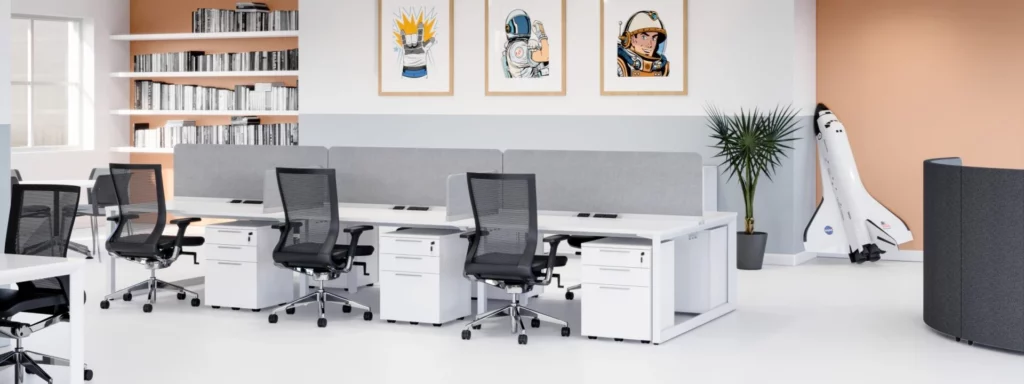
- Mobile pedestals: On casters, so they can roll out for cleaning or reconfiguration and double as guest seating in a pinch (check the weight rating first). The flexible choice for agile and hybrid offices.
- Locks: Specify locking pedestals for HR, finance, and anyone handling confidential material. Central keying — one key opens all of a user’s locks — avoids the dreaded key-ring sprawl.
Lateral Files: The Workhorse of Shared Storage
Lateral file cabinets — wide, shallow drawers that hold files side-to-side — are the backbone of most office storage walls. A two-drawer lateral roughly equals a four-drawer vertical file in capacity while keeping everything at reachable height. Key points:
- Anti-tip interlocks: Non-negotiable. Only one drawer should open at a time; a fully loaded lateral with multiple drawers open can tip forward with serious force.
- Weight: Full file drawers are extremely heavy. Confirm floor loading, especially in older Vancouver buildings and on raised floors, and never plan to move a loaded cabinet.
- Counterweight and anchoring: Tall or narrow units should be anchored or ganged together. Freestanding tall storage in earthquake country — which the Lower Mainland is — should always be secured.
- Fire-rated options: For vital records, fire-rated file cabinets protect contents for one to two hours. Worth it for legal, medical, and financial originals.
Vertical Files, Cabinets, and Wardrobes
- Vertical files: The classic four-drawer cabinet. Deep footprint, high capacity per square foot of floor, but the top drawers are a reach and the bottom drawer is a crouch. Fine for archives; less ideal for daily access.
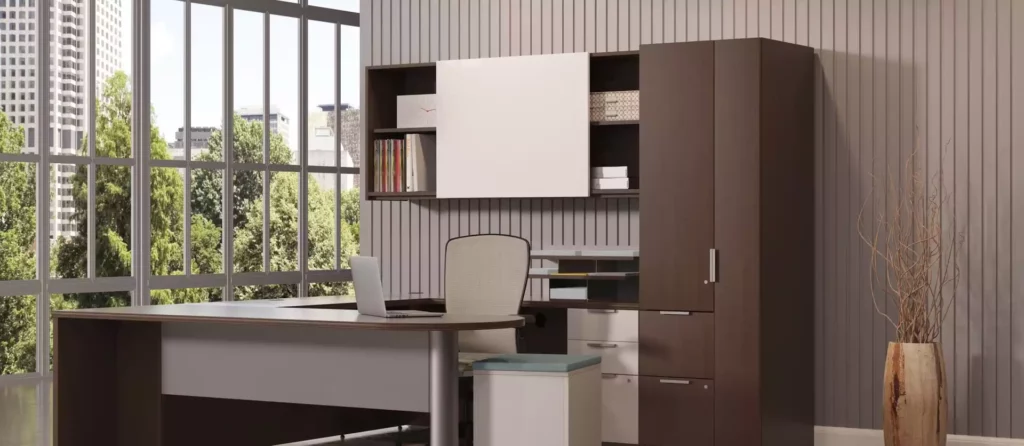
- Storage cabinets: Adjustable shelves behind doors handle binders, supplies, and equipment that do not fit file drawers. Add a wardrobe cabinet with a coat rod near entrances and nobody drapes jackets over chairs.
- Bookcases: Open shelving for reference libraries and display. In client-facing areas, bookcases with a mix of books and curated objects read as established and credible.
- Wall-mounted and overhead storage: Bins and shelves above desks reclaim vertical space in small offices — but keep them shallow (12–15 inches) and within comfortable reach, and never load them above the manufacturer’s rating.
Planning a File Room
When records outgrow workstation storage, a dedicated file room earns its keep:
- High-density mobile shelving: Shelving units on floor tracks that compact together, opening one aisle at a time. Roughly doubles capacity versus static shelving in the same room. Needs a level floor and professional installation.
- Static shelving: Simpler and cheaper. Standardize box sizes and label every shelf — a file room without a labelling system becomes a write-only archive.
- Climate: Keep file rooms cool and dry. Vancouver’s humidity can encourage mould on long-stored paper; a dehumidifier in windowless interior rooms is cheap insurance.
- Access control: A lockable file room with a sign-out log satisfies most privacy requirements for employee and client records.
And set a retention policy. Most business records have legal retention periods — often seven years for financial documents in Canada — after which secure shredding frees enormous space. A file room without a destruction schedule just fills up.
Storage for Hybrid and Paper-Light Offices
Not every office needs walls of files. If your team is mostly digital:
- Personal lockers or cubbies: Hybrid workers need somewhere to stash a laptop bag, charger, and personal items on office days. Day-use lockers near the entrance beat cluttered desks.
- Team storage walls: One shared cabinet per team for the supplies and reference material that is genuinely shared, instead of everyone hoarding their own.
- Clean-desk enablers: Hot-desking only works with somewhere to put things. Under-desk mobile pedestals assigned per booking, or personal lockers, make the clean-desk policy realistic instead of resented.
Frequently Asked Questions
How much file storage does our office actually need?
Audit first, buy second. A rough rule: one lateral file drawer holds about 5,000–6,000 sheets in hanging folders. Most 20-person offices with moderate paper use manage with 6–10 lateral file drawers of shared storage plus personal pedestals — far less than they assume before purging.
Are vertical or lateral files better?
Lateral files win for daily use: everything is at a comfortable height, drawers hold more per drawer, and they double as a surface for printers or reference material. Vertical files win on capacity per square foot of floor space, making them better for archives and file rooms.
How do we keep confidential files secure?
Locking pedestals and cabinets with central keying for personal storage, a lockable file room with access control for shared records, and a clean-desk policy so sensitive papers are not left out overnight. For highly sensitive material, consider fire-rated locking cabinets.
What should we do with old files we no longer need?
Check retention requirements first — financial and HR records have legal minimums. Beyond that, use a certified secure shredding service (many operate across Metro Vancouver with scheduled pickups) rather than recycling bins, and document the destruction for compliance.
Good storage is invisible: everything has a place, nothing piles up, and nobody wastes time hunting for files. Whether you need a few pedestals, a wall of lateral files, or a fully planned file room, M&E Business Furnishings supplies and installs storage solutions across Metro Vancouver. Call 604-200-7961, email info@meimport.com, or visit mefurn.com for a storage assessment and quote.
M&E Business Furnishings | info@meimport.com | 604-200-7961 | mefurn.com