Open-plan offices promised collaboration and delivered a soundtrack: ringing phones, overlapping video calls, the sales team celebrating two desks from someone writing a report. Noise is now consistently ranked among the top complaints in open offices — and the research backs the frustration up. Background speech is uniquely distracting because the human brain is wired to tune into conversation, and studies show it can take over twenty minutes to fully refocus after an interruption. The good news: acoustic design is a solvable problem, with solutions for every budget. Here is how Vancouver offices are quieting down.

Understand What You Are Fighting
Office noise comes in three forms, and each needs different treatment. Airborne speech — conversations, calls, video meetings — is the most distracting and the most addressable. Impact noise — footsteps, rolling chairs, doors — travels through structure and flooring. And background systems noise — HVAC hum, traffic — sets the floor everything else sits on. A proper acoustic plan addresses all three, but start with speech: it causes the most lost productivity per decibel.
Before spending, measure. Free smartphone apps give a rough sense of ambient levels; open offices typically run 55–70 dB, while focused work wants 40–50 dB. Note when and where peaks occur — the pattern tells you whether you need targeted treatment (the loud sales pod) or broad treatment (the whole floor).
Layer 1: Absorb Sound With Soft Surfaces
Hard surfaces reflect sound; soft surfaces absorb it. Every upholstered chair, fabric panel, carpet tile, and curtain in the office is doing quiet acoustic work. The fastest wins:
- Acoustic wall panels: Fabric-wrapped panels on walls — especially parallel walls that bounce sound back and forth — cut reverberation dramatically. They come in colours, prints, and even custom artwork, so treatment doubles as design.
- Ceiling treatment: The ceiling is the largest reflective surface in most offices. Acoustic ceiling tiles or suspended baffles absorb sound before it spreads across the floor.
- Flooring: Carpet tile over concrete is one of the highest-value acoustic investments in hard-surfaced Vancouver lofts. It kills footfall noise and takes the edge off everything else.
- Soft furnishings: Upholstered lounge seating, fabric screens, and even plants contribute. Offices that feel calm almost always have more soft surfaces than hard ones.
Layer 2: Block Sound at the Workstation
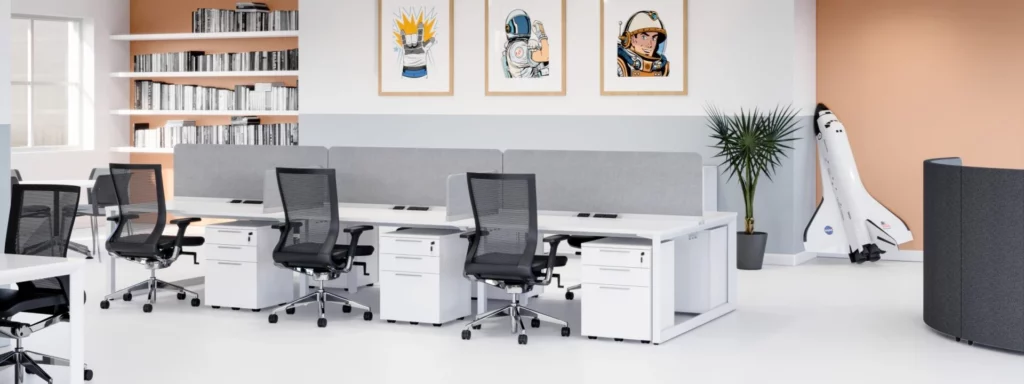
Absorption calms the room; blocking protects the individual. Acoustic desk screens mounted to worksurfaces — look for Class A absorption ratings — cut speech-frequency noise right where people work, making nearby conversations less intelligible and less distracting. They preserve the open feel and sightlines while giving each workstation a calmer micro-environment. Screen-mounted accessories (monitor arms, organizers, shelving) add function to the acoustic investment.
For bigger noise problems, acoustic pods provide genuinely quiet space for calls and focused work without construction. A pod per 15–25 open-plan employees is a common planning ratio, adjusted upward for call-heavy teams. Freestanding pods avoid permits and move with you at lease end — a serious advantage in Vancouver’s leased market.
Layer 3: Zone by Noise Level
The cheapest acoustic treatment is layout. Put loud activities — sales calls, brainstorming, social lunches — farthest from focus work. Buffer zones (storage walls, corridors, print areas) between noisy and quiet areas absorb more sound than people expect. Designate loud and quiet zones explicitly and give each the furniture to match: collaboration furniture and writable surfaces in loud zones; focus pods and library-quiet expectations in quiet ones.
Meetings deserve special attention. Every ad-hoc discussion that happens at a desk is noise for six neighbours. Providing enough small meeting rooms and huddle spaces — and making them bookable and pleasant — pulls conversation out of the open floor naturally.
Layer 4: Mask What Remains
Sound masking — carefully tuned background sound played through ceiling speakers — does not eliminate noise but makes speech less intelligible and less distracting. It is particularly effective in offices where confidential conversations happen near open work areas: HR discussions, client calls, financial reviews. Modern masking systems are subtle; occupants typically stop noticing within days while the privacy benefit persists. For open offices with private offices along the perimeter, masking in the ceiling void protects both.
What to Prioritize on a Budget
If you can only do three things, do these: carpet or rugs over hard floors, acoustic panels on the worst reflective walls, and enough huddle space to pull meetings off the open floor. That combination addresses the majority of complaints for a fraction of a full acoustic retrofit. Add desk screens next, then pods, then masking as budget allows.
Measuring Success: Before and After
Acoustic projects benefit from simple measurement. Take baseline readings with a phone app at different times of day, note where complaints cluster, then re-measure after treatment. Even more telling: survey the team. Ask how often noise disrupts focus now, and ask again a month after the changes. The combination of decibel numbers and human feedback tells you whether the investment worked — and builds the case for the next phase of treatment if more is needed.
Frequently Asked Questions
How much noise reduction can we realistically expect?
A well-executed layered plan typically drops perceived noise dramatically — reverberation times can fall 40–60 percent with absorption treatment alone. The goal is rarely silence; it is reducing speech intelligibility and peak distractions to the point where focus work becomes possible.
Do acoustic panels actually work, or are they decorative?
Proper acoustic panels with rated absorption coefficients (NRC 0.7+) genuinely work — the physics is well established. Decorative-only “acoustic art” with no rated backing does far less. Always check the NRC rating before buying.
Will sound masking bother employees?
Properly tuned masking sits just below conscious awareness — most people describe it as similar to soft airflow. Poorly tuned systems (too loud, wrong spectrum) do annoy people, which is why professional calibration matters.
Can we fix acoustics in a leased space without construction?
Absolutely. Freestanding acoustic screens, pods, rugs, furniture-mounted panels, and masking are all non-permanent. This is one of the easier office improvements to make in leased Vancouver space.
Noisy open offices are a design problem with known solutions — and every decibel of improvement pays back in focus and sanity. M&E Business Furnishings supplies acoustic panels, desk screens, pods, and full acoustic planning across Metro Vancouver. Call 604-200-7961, email info@meimport.com, or visit mefurn.com for an acoustic assessment of your office.
M&E Business Furnishings | info@meimport.com | 604-200-7961 | mefurn.com